
- Home
- Artists & Makers
- Abraham Cooper RA
Abraham Cooper RA
1787 - 1868
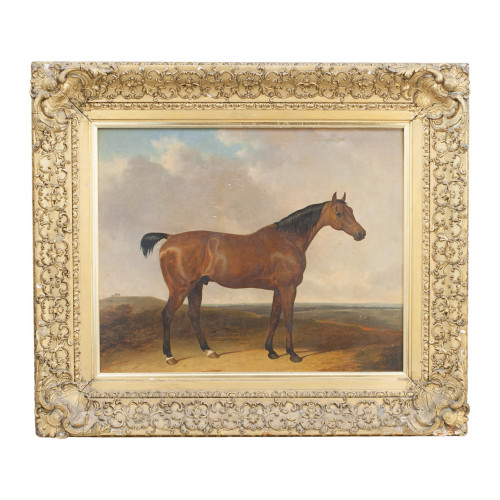
Abraham Cooper RA (1787-1868) was a celebrated British sporting and animal painter, particularly renowned for his accomplished portraits of horses, hunting scenes and military subjects. His remarkable career began not in an artist's studio, but in the stables, where he developed the intimate knowledge of horses that would become the foundation of his artistic success.
Born in Greenwich, London, on 8 September 1787, the son of a tobacconist, Cooper began working at Astley's Amphitheatre at the age of thirteen. He later became a groom in the service of Henry Meux, the wealthy London brewer and later first Baronet Meux.
At the age of twenty-two, wishing to preserve the likeness of a favourite horse in his care, Cooper purchased a manual on oil painting and taught himself the rudiments of the art. His first attempt was painted on a canvas hung against a stable wall. So impressed was his employer with the resulting portrait that he purchased the picture and encouraged Cooper to pursue his artistic talent.
Inspired by this early success, Cooper began copying sporting prints and studying the anatomy and movement of horses. He was subsequently introduced to Benjamin Marshall, the established sporting and animal painter, who offered him guidance and the opportunity to work in his studio. Through Marshall, Cooper also became associated with The Sporting Magazine, for which he produced equestrian illustrations.
Cooper first exhibited at the Royal Academy in 1812, and his reputation steadily grew. He was elected an Associate of the Royal Academy in 1817 and a full Royal
Academician in 1820, a remarkable achievement for a largely self-taught artist whose career had begun as a stable groom.
Although best remembered for his sporting pictures and portraits of horses, Cooper was also an accomplished painter of historical and military subjects, particularly cavalry engagements, in which his understanding of equine anatomy and movement was especially evident.
His paintings are admired for their careful observation, naturalistic detail and ability to convey the individual character of the animals he depicted. His lifelong familiarity with horses gave his work an authenticity that distinguished him among the leading British sporting artists of the 19th century.
Cooper continued painting and exhibiting throughout a long and successful career, becoming one of the most respected equestrian artists of his generation. He died on 24 December 1868, aged eighty-one, leaving an important legacy in the tradition of British sporting art.
1 ITEM
Please create wishlist to add this item to
