
- Home
- Artists & Makers
- Finnigans
Finnigans
1830
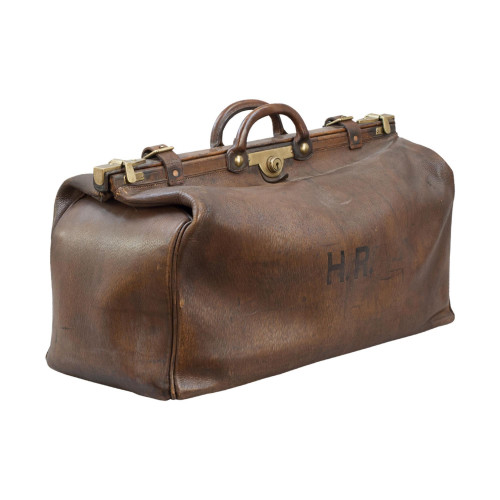
Finnigans of London, Manchester, and Liverpool ranks among the finest English luggage manufacturers of its era. Renowned not only for exceptional luggage and leather goods, the company also became a highly successful luxury retailer, producing and selling an extensive range of premium products, including trunks, bags, fashion accessories, jewellery, timepieces, and silverware.
The business was founded by Benjamin Finnigan, who traded as Brian B. Finnigan, in the 1830s. Before establishing his own firm, he apprenticed under Reuben Farrel, a sailing partner of his father. Together, Farrel and Finnigan crafted leather goods in Liverpool, specialising in bags and trunks designed to withstand the long and often arduous journeys of the time.
As Manchester prospered during the cotton boom, both men relocated there. Finnigan went on to establish his own workshop at Newton Street Mill and opened a Finnigans shop on Market Street, then one of Manchester's most fashionable commercial districts. He quickly earned a reputation for the quality of his dressing cases, travelling trunks, leather goods, and saddlery.
Following Benjamin Finnigan's death in 1868, the business passed to his son, William Finnigan, who represented the second generation of the family enterprise. In 1879, William opened a Finnigans store on New Bond Street in London, notably situated opposite Asprey, another prestigious luxury retailer. Around this period, the company expanded its offering to include clocks, watches, and silverware.
The business remained under family ownership for several generations. During the 1950s, the Manchester store relocated to Wilmslow, and in 1968 the New Bond Street premises in London closed.
Finnigans of London, Manchester, and Liverpool ranks among the finest English luggage manufacturers of its era. Renowned not only for exceptional luggage and leather goods, the company also became a highly successful luxury retailer, producing and selling an extensive range of premium products, including trunks, bags, fashion accessories, jewellery, timepieces, and silverware.
The business was founded by Benjamin Finnigan, who traded as Brian B. Finnigan, in the 1830s. Before establishing his own firm, he apprenticed under Reuben Farrel, a sailing partner of his father. Together, Farrel and Finnigan crafted leather goods in Liverpool, specialising in bags and trunks designed to withstand the long and often arduous journeys of the time.
As Manchester prospered during the cotton boom, both men relocated there. Finnigan went on to establish his own workshop at Newton Street Mill and opened a Finnigans shop on Market Street, then one of Manchester's most fashionable commercial districts. He quickly earned a reputation for the quality of his dressing cases, travelling trunks, leather goods, and saddlery.
Following Benjamin Finnigan's death in 1868, the business passed to his son, William Finnigan, who represented the second generation of the family enterprise. In 1879, William opened a Finnigans store on New Bond Street in London, notably situated opposite Asprey, another prestigious luxury retailer. Around this period, the company expanded its offering to include clocks, watches, and silverware.
The business remained under family ownership for several generations. During the 1950s, the Manchester store relocated to Wilmslow, and in 1968 the New Bond Street premises in London closed.
Finnigans continued to operate as a family business until its final store closed in 1988. Around this time, the company was acquired by Hoopers.
Throughout its history, Finnigans continually adapted its travel goods to meet the changing demands of modern transportation, evolving from the railway age to the advent of the motor car and, later, air travel. The name "FINNIGANS" is frequently found embossed three or four times on the exterior of its luggage, often accompanied by the names London, Manchester, or Liverpool, or various combinations of the three cities.
5 ITEMS


Please create wishlist to add this item to
